
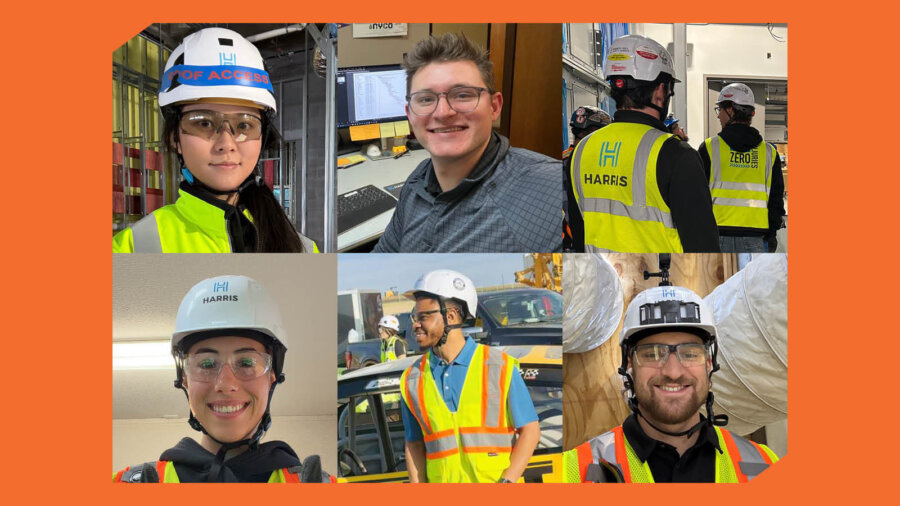
Inside the Harris PM Rotational Training Program
Building Future Project Leaders: Inside Harris’ PM Rotational Training Program
Our Project Manager Rotational Training Program is designed to accelerate the development of future project leaders by giving early-career professionals hands-on experience across the organization. The construction industry demands leaders who understand both the technical details and the broad operational goals of a project. We created this 18 to 24-month program to provide that exact foundation.
Over the course of two years, participants rotate through multiple business units, locations and disciplines across Harris, gaining firsthand experience in everything from field operations and estimating to engineering, manufacturing and project management. The goal is simple: develop future project leaders who understand the full picture of how projects are planned, built and delivered.
For participants like Edward Obasuyi, Olivia Kloehn and Thomas Anderson, that broad exposure has become one of the program’s greatest strengths.
Learning the Business from Every Angle
Each trainee arrived at Harris with a different background and motivation, but all were drawn to the opportunity to accelerate their professional growth.
For Obasuyi, a mechanical engineer with a passion for commercial HVAC and piping systems, the program offered a chance to expand beyond technical expertise and develop the broader leadership skills needed to manage complex projects.
“I wanted to move beyond the technical side of projects and develop the skills to coordinate complex workflows, drive informed decision-making and take ownership of outcomes both technical and financial,” Obasuyi said.
Kloehn was attracted to the structure of the program itself. The opportunity to spend two years rotating through different business units and gaining hands-on experience across the company stood out as a unique way to build a foundation for a long-term career.
“I’ve always liked the idea of a rotational program because it gives you a well-rounded understanding of the business,” Kloehn said. “What stood out to me about Harris was how robust the program is and the fact that you can complete it in two years.”
For Anderson, the appeal was simple: learn as much as possible, as quickly as possible.
“The biggest reason that I wanted to apply for the rotational program was that I was early into my career and was just beginning to learn how little I knew,” Anderson said.
Seeing the Bigger Picture
One of the most valuable aspects of the rotational program is the opportunity to work with multiple business units and teams across different regions.
Rather than learning a single piece of the business, trainees gain exposure to the many groups that contribute to successful project delivery. That broader perspective helps them understand not only what each team does, but also how those teams work together.
Kloehn said working in different locations has been especially eye-opening.
“I’ve been able to see how many moving parts there are within Harris and how each business unit operates a bit differently while still sharing the same values,” she said.
Obasuyi experienced something similar while rotating through different teams and locations. He said those experiences reinforced the importance of collaboration and showed how successful projects depend on alignment across an entire organization.
“Successful project delivery isn’t just a technical achievement,” Obasuyi said. “It’s a product of intentional collaboration across every level of an organization.”
For Anderson, the biggest takeaway has been perspective.
Each team operates differently based on its market, customers and regional needs. While there are common processes and structures across Harris, no two teams are exactly alike. Understanding those differences has helped him appreciate the many factors that influence project decisions and outcomes.
Building a Foundation for Project Management
The rotational program is designed to prepare participants for future project management roles, and trainees consistently point to the breadth of exposure as one of its most valuable benefits.
By spending time with estimating teams, engineering groups, field operations, manufacturing professionals and project managers, participants develop a deeper understanding of how projects move from concept to completion.
Obasuyi said the program has provided a foundational understanding of the entire mechanical construction value chain.
That broader knowledge has helped him identify where processes naturally accelerate, where bottlenecks tend to occur and how different teams contribute to project success. Those insights will be invaluable as he transitions into a project management role.
Anderson believes the accelerated learning environment is unlike anything else available to young professionals entering the industry.
“The ability to expedite so much learning with so many different topics and subjects is not something you will get anywhere else,” Anderson said.
More Than Technical Knowledge
While technical development is a major component of the program, participants say some of the most meaningful benefits come from the relationships they build along the way.
Kloehn entered the program without a construction background and quickly discovered that the people around her were eager to help her learn.
“This program has helped me more than I could’ve imagined,” Kloehn said. “I’ve gained technical knowledge and built connections with people I know I can reach out to whenever I need help or advice.”
Anderson echoed that sentiment, noting that many of the relationships formed during his rotations are ones he expects to carry throughout his career.
“The relationships and friendships made through these rotations I won’t forget,” he said.
Preparing the Next Generation of Leaders
As participants move closer to completing the program, they consistently point to the same outcome: confidence.
Confidence in their understanding of the business. Confidence in their ability to collaborate across teams. And confidence in their readiness to take on larger responsibilities.
For Harris, that’s exactly the objective.
By exposing trainees to every stage of project delivery and providing opportunities to learn from experienced professionals across the company, the PM Rotational Training Program is helping develop the next generation of project leaders.
Categories: Blog