
Lessons from the Jobsite: Insights from Harris PM Rotational Trainees
Lessons from the Jobsite: What Harris PM Trainees Learn In the Field
The Harris PM Rotational Training Program is designed to expose participants to every stage of project delivery, but the most impactful lessons aren’t found in training materials or presentations.
They’re learned in the field.
Whether working alongside craft professionals, observing fabrication processes or participating in project meetings, trainees quickly discover that real-world experience offers lessons that simply can’t be replicated in a classroom.
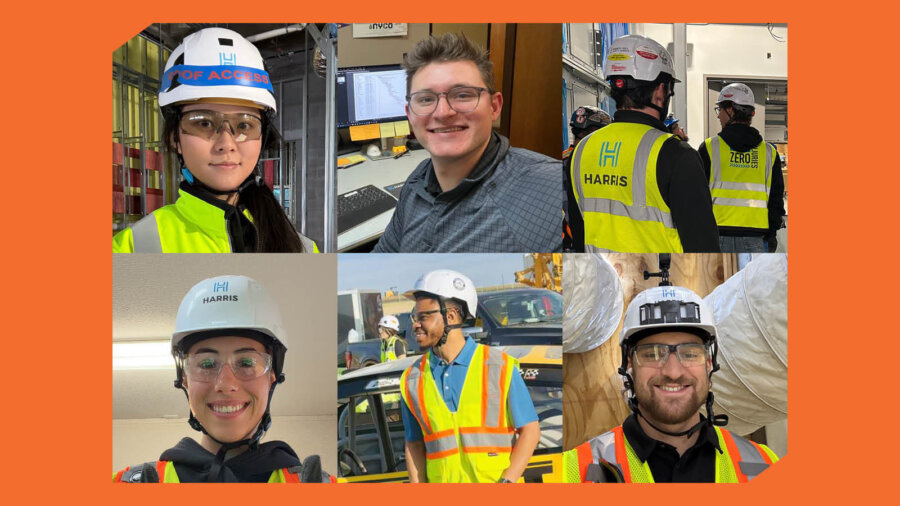
For PM Rotational Trainees Edward Obasuyi, Olivia Kloehn and Thomas Anderson, those experiences have become some of the most memorable parts of the program.
Where Learning Becomes Real
For Obasuyi, the field rotation was both his favorite and most challenging assignment.
“It might seem contradictory to name the same rotation as both my favorite and my most challenging, but that’s exactly what made it so valuable,” he said.
The field environment provided a firsthand look at the realities of project execution. Coordinating logistics, managing installation sequences, communicating across trades and solving problems in real time all required a level of awareness and adaptability that can’t be fully appreciated until you’re on a jobsite.
“There’s no margin for passivity out there,” Obasuyi said. “You must be proactive or you fall behind.”
What made the experience especially meaningful, however, was the opportunity to learn directly from experienced craft professionals.
“The field team carries an extraordinary depth of craft knowledge, and they were genuinely open to sharing it,” he said.
Kloehn found similar value during her field rotation in Virginia as well as her estimating rotation in St. Paul. Both experiences helped her develop a stronger understanding of the industry while introducing her to teammates who encouraged questions and supported her growth.
“Both teams were incredibly supportive and always encouraged me to ask questions,” Kloehn said.
One of her favorite memories from the program came during her time in Virginia, where she was able to spend time with the broader project team outside of daily work activities and build stronger relationships with colleagues.
Understanding How Projects Come Together
For Anderson, some of the most valuable lessons came from seeing projects through multiple lenses.
His field rotation in Rochester provided a closer look at day-to-day project execution, while his manufacturing rotation at Harris Manufacturing Facilities in Zumbrota offered insight into the planning and coordination that happens before materials ever reach a jobsite.
Seeing fabrication activities firsthand helped him better understand scheduling, installation planning and the role prefabrication plays in successful project delivery.
The experience also allowed him to participate in conversations with project teams and observe how decisions affect both manufacturing and field operations.
Those perspectives helped create a more complete understanding of the project lifecycle and reinforced the importance of collaboration between teams.
Advice for the Next Generation
As trainees gain experience across the business, they also develop lessons they wish they had known when first entering the industry.
For Anderson, one message stands above the rest.
“Relationships are everything,” he said.
Construction is ultimately a people business. Projects succeed when teams communicate effectively, build trust and work together toward a common goal. Developing strong interpersonal skills, Anderson believes, is one of the most important investments a young professional can make.
Kloehn’s advice is equally straightforward.
“Don’t be afraid to ask questions,” she said.
Early in a career, it can be easy to feel pressure to have all the answers. Her experience at Harris has shown her that curiosity and a willingness to learn are far more valuable.
“No one expects you to know everything right away,” Kloehn said.
Why Construction?
Ask construction professionals why they chose the industry and you’ll often hear a wide variety of answers.
For these trainees, however, a common theme emerged: the opportunity to see the direct impact of their work.
Obasuyi said one of the industry’s most rewarding aspects is the ability to see tangible results from the decisions made throughout a project.
Unlike many careers where outcomes may feel distant or abstract, construction provides immediate feedback. Teams can see the results of their planning, coordination and problem-solving take shape in real time.
Kloehn appreciates the hands-on nature of the industry and the sense of accomplishment that comes with seeing a project completed.
“There’s something special about being able to point to a finished project and know you were a part of it,” she said.
Anderson highlighted the complexity of the systems Harris designs and installs, as well as the endless opportunities for continued learning.
“I like how challenging and sophisticated the systems are within mechanical, plumbing, controls and specialty systems,” Anderson said.
Looking Ahead
All three trainees believe the industry offers tremendous opportunities for the next generation of professionals.
From healthcare and advanced manufacturing to data centers and commercial construction, the need for skilled project leaders continues to grow. At the same time, the complexity of modern projects creates opportunities for individuals who are eager to learn, collaborate and take on new challenges.
That’s exactly what the PM Rotational Training Program is designed to cultivate.
By providing hands-on experience, exposure to multiple business units and opportunities to learn from experienced professionals across Harris, the program helps prepare participants for successful careers in project management.
Categories: Blog